

Wes Moore Went on "CBS’ Town Hall" and Said What Democrats Hate Hearing: Y’all Move Too Slow
At CBS’ “Things That Matter” town hall, Maryland Gov. Wes Moore took shots at Trump—but the sharper warning was aimed at Democrats addicted to process while voters are begging for outcomes.


By the time Norah O’Donnell finished setting the scene in Cambridge, Maryland—historic town, Underground Railroad lore, civil rights echoes—you could already tell what CBS wanted this hour to be: a glossy audition tape for Gov. Wes Moore as “the future of the Democratic Party.”
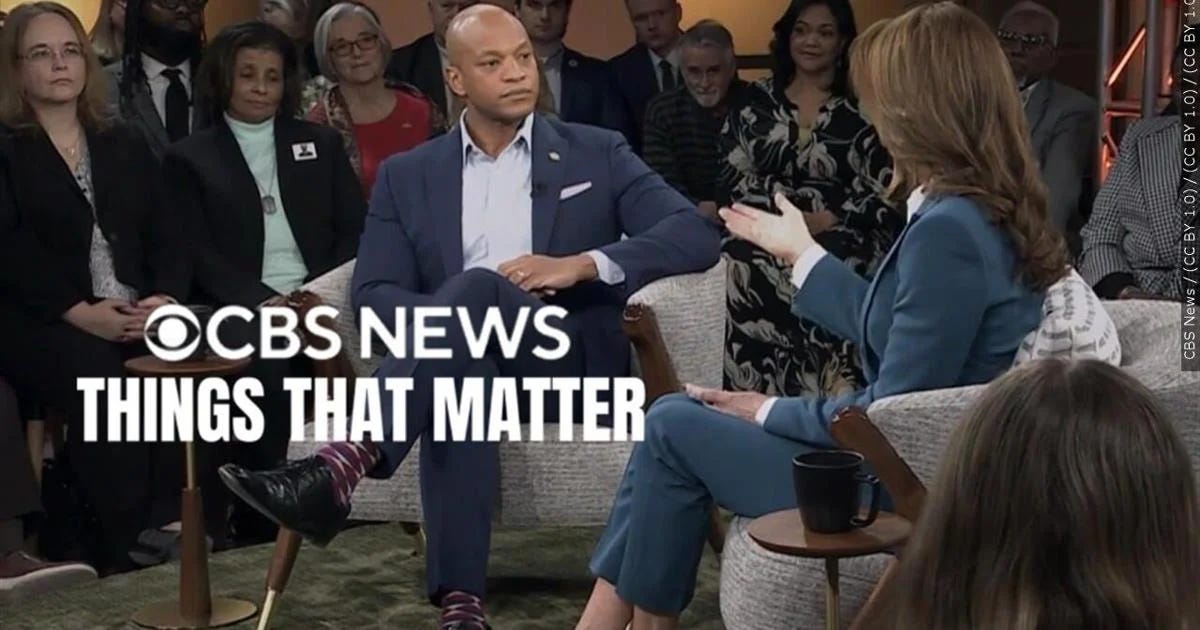
And honestly? Moore played the role like he understood the assignment.
But here’s the twist: the most important thing Moore did wasn’t flirt with 2028. It was drag his own party for being allergic to urgency—while staring straight at a country that’s watching Trump-style politics sprint across the field like it stole the whistle.
Because that’s where we are. This isn’t the “ideas marketplace.” It’s speed chess with consequences.
“No and slow” is a death sentence
Moore’s clearest argument—under all the talk about Trump, Epstein, immigration, rising prices, and the general vibes of national dysfunction—was basically this:
Democrats can’t keep responding to real pain with studies, task forces, commissions, and “we’re going to explore options.”
People aren’t asking for a five-year plan. They’re asking if you see them right now.
And yes, that’s partly an indictment of the party. Not because Democrats don’t have policies. They do. The problem is they keep communicating like the policy itself is the victory. Like the press conference is the finish line. Like the spreadsheet is dinner.
Meanwhile, the other side is moving like they don’t even believe in guardrails.
That’s why Moore’s framing hit: the question isn’t whether Democrats are right. The question is whether they’re credible as doers. Whether they can execute with enough speed to match the moment without turning into the moment.
That’s the needle.Trump insulted him—Moore refused to audition for the circus
CBS made sure to include Trump’s usual brand of public disrespect toward Moore—calling him “foul-mouthed,” accusing him of lying about military medals, blaming him for Baltimore crime, and the Francis Scott Key Bridge rebuild.
And Moore didn’t do what a lot of Democrats do in these moments: the trembling, over-explaining, “let me clarify the record” thing.
He basically said: I’m not doing mental gymnastics inside Trump’s psyche. I have a state to run.
That matters.
Because one of the ways Trump dominates the room—even when he’s not in it—is by forcing his opponents to speak in his language. To respond on his terrain. To spend precious minutes addressing disrespect instead of delivering power.
Moore’s move was: I’m not playing.
He repositioned it as a leadership argument: leadership means building a table, integrity, making people feel like they belong here. And Trump’s behavior, he suggested, isn’t just beneath the office—it’s beneath the country.
That’s the best version of “don’t wrestle the pig.” You can’t win the mud contest. You can only refuse it.

The racism question—and Moore’s most telling answer
Norah asked the question America always asks Black leaders like it’s a pop quiz: “Do you believe Trump is racist?”
Moore didn’t take the bait in the simplistic way. He didn’t do the cable-news “Yes, obviously” mic drop. He said (paraphrasing): ask Trump. But I can tell you how his actions land on Black people and people of color.
Then he ticked through the impact: assaults on HBCU scholarship programs, attacks on Black female employment, book bans, history minimization, and the grotesque “apes” imagery aimed at the Obamas.
That answer matters not because it’s clever—it’s because it’s strategic. Moore refused to let the conversation become a morality play about one man’s heart. He forced it back to outcomes.
Black people have been trapped in this cycle forever: prove the racism, explain the racism, document the racism, debate the racism—while living inside the consequences of the racism.
Moore’s answer was basically: you don’t need an admission when the evidence has a body count.
Immigration: the rare Democrat who said “Biden didn’t have it right” without self-sabotage
On immigration, Moore did something Democrats struggle to do: admit failure without handing over the whole argument.
He said what a lot of people already know: the immigration system is broken and Congress has punted for decades. He acknowledged the Biden years weren’t some clean, solved era—and then pivoted to what Democrats don’t do enough of: talking about competence and reform in the same sentence as human dignity.
He also drew a bright line around ICE enforcement practices and accountability—arguing that if untrained, unqualified, unaccountable agents are being deployed into communities, the state has a responsibility to keep people safe.
This is where “yes and now” either becomes real—or collapses. Because immigration is the kind of issue where “faster” can mean “crueler” if you aren’t careful. Moore’s pitch is that you can be decisive without becoming inhumane. Voters want order. They also want the country to still be the country.
That’s not easy. But it’s necessary.

Epstein: “Accountability” is the last bipartisan language left
If there was one moment where you could feel the entire room—left, right, tired, cynical—lock into the same frequency, it was Epstein.
Moore called the details sickening and grotesque and demanded accountability for anyone found guilty—regardless of background or political affiliation. He pointed to the core trust problem: people feel like “we’ve known” for a long time and yet almost nobody has faced consequences.
This is bigger than Epstein. This is the institutional crisis in one sentence:
When people believe elites can harm children and still walk free, they stop believing anything else the system says.
They stop distinguishing between error and cover-up.
They stop trusting investigations.
They stop trusting courts.
They stop trusting journalists.
They stop trusting each other.
That’s how societies break.
Moore tapped into something real: America is spiritually exhausted from watching “accountability” be a slogan instead of a verb.
The most important exchange was with a Black Republican woman
And this is where Moore either earned his reputation—or proved he’s just another talented messenger.
A Black woman in the audience—registered Republican, digital media business owner, former Democrat—basically said what you hear more and more:
“I left because I got tired of racial framing on every issue that didn’t solve real problems like crime, failing schools, high taxes, and cost of living. How do you earn voters like me back who want results, not racial narratives?”
Here’s what Moore didn’t do:
He didn’t scold her.
He didn’t “well actually” her.
He didn’t treat her like a betrayal story.
He agreed with the premise that outcomes matter, and then reframed the assignment for Democrats: it’s not just to energize the base—it’s to enlarge it. Speak to everybody. Show up in places you lost. Deliver results, and people will find their political home where results live.
That answer is the only path forward.
Because the truth is: people don’t abandon Democrats because they suddenly love conservative ideology. A lot of times, they abandon Democrats because they don’t feel like Democrats are building a life that works.
Results are persuasive.
Lectures are not.

So what was this, really?
This was Wes Moore presenting himself as a different kind of Democrat: an operator with narrative skill. A leader who wants to move with urgency without losing legitimacy. Someone trying to be tough without being theatrical.
And if Democrats are serious about surviving the next few years, they need more than charismatic prosecutors of Trump.
They need governors who can show receipts.
They need leaders who can talk like adults and govern like the building is on fire.
Moore’s “yes and now” line is either a real governing philosophy—or it’s another slogan destined to die in a focus group.
But for one hour in Cambridge, he made the case that Democrats don’t have a messaging problem.
They have a velocity problem.
And in the era we’re in, slow isn’t thoughtful.
Slow is fatal.