

The Day You Plant the Seed Is Not the Day You Eat the Fruit
Candace O’Neal paints the long, quiet distance between planting, waiting and finally becoming

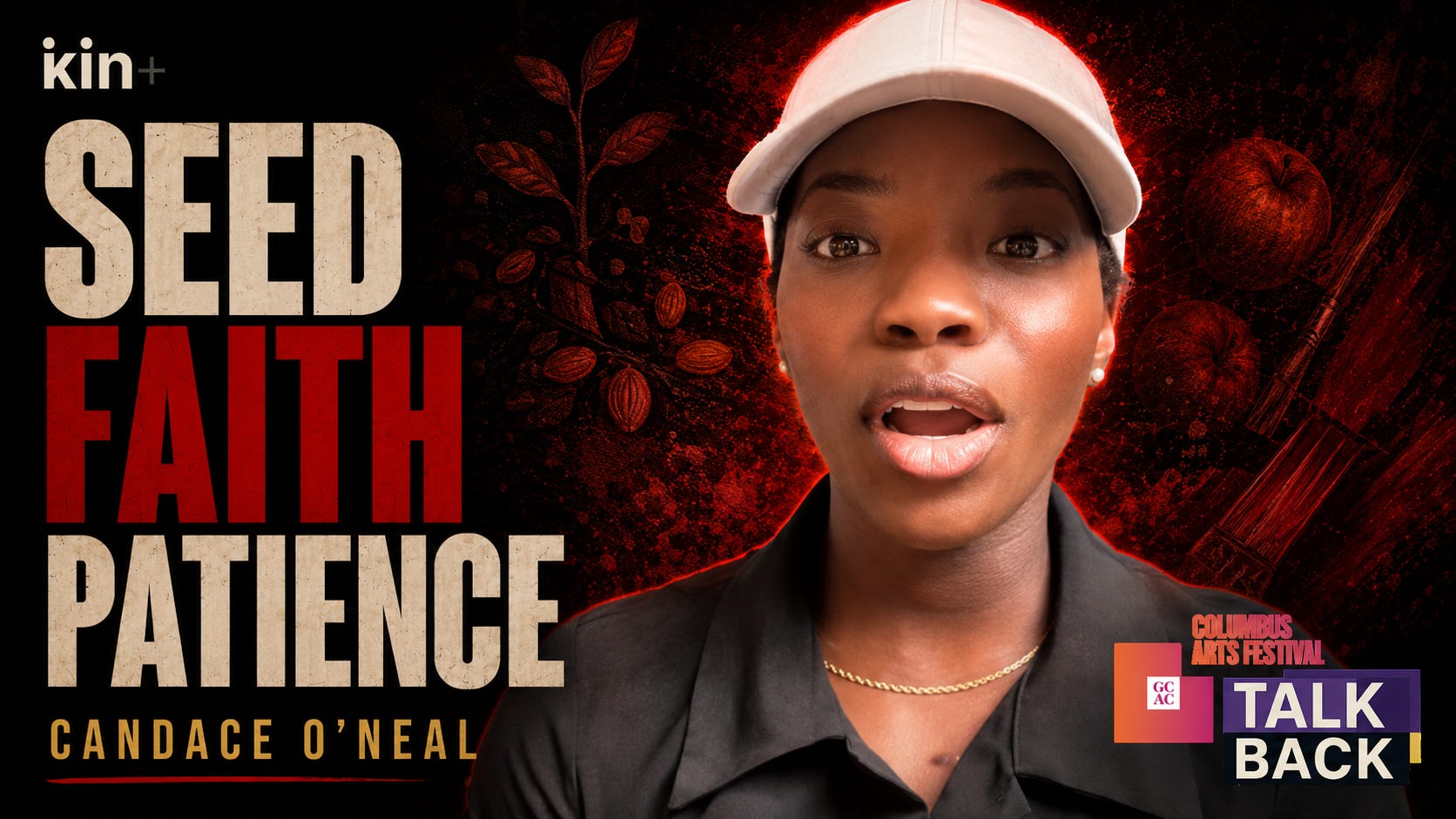
Before Candace O’Neal had a studio, she had a shed.
It sat in her mother’s backyard, small enough to make ambition feel crowded but equipped with the essentials: electricity, air conditioning and enough separation from the rest of the world for an artist to hear herself think. During the summer, O’Neal would drive over, disappear inside and work for hours. Outside, birds chirped. Rain struck the roof. Natural light moved across the yard.
Inside, a woman was growing a body of work before she had the space—or perhaps the nerve—to call what she was building a career.
There is a temptation to romanticize arrangements like this after the artist has moved on from them. We like origin stories once we know they have happy endings. The garage becomes a startup incubator. The church basement becomes a legendary rehearsal hall. The backyard shed becomes proof that greatness does not require square footage.
That is all true. It is also incomplete.
Sometimes the shed is simply too small.
O’Neal eventually understood that gratitude for where she had started could not become an excuse for refusing to expand. A photographer friend encouraged her to tour available spaces in the building where she worked. O’Neal found a studio with a large window, moved in and created a ritual: music on, outside world off.
“As soon as the music goes on, I’m locked in,” she said. Hours can disappear before she notices she has not eaten or moved from the canvas. The studio offers twenty-four-hour access, which is useful when inspiration refuses to respect office hours.
The shed was not a failure. It was a season.
That distinction matters to O’Neal because seasons—what they demand, what they produce and how long they make us wait—sit at the center of her art.
“The day you plant the seed is not the day you eat the fruit,” she told me.
That sentence is the organizing principle of her current work, particularly a collection built around fruit, patience and spiritual maturity. O’Neal’s paintings do not always portray her experiences literally. A canvas about waiting will not necessarily show a woman checking the clock, refreshing her email or asking God for the fifteenth time whether He saw the previous fourteen messages.
Instead, she paints the process through symbol, color and atmosphere.
A seed goes into the ground looking like disappearance. Nothing above the surface immediately confirms that the work has begun. Water it today and the earth still looks like dirt tomorrow. Human beings, especially those raised in a culture of overnight virality, two-day shipping and same-hour outrage, are not naturally gifted at this part.
We want the fruit while the seed is still adjusting to the soil.
O’Neal has been learning not to confuse invisibility with inactivity. Growth can be real before it becomes public. She describes impatience as something capable of uprooting what we have already planted—the emotional equivalent of digging into the dirt every morning to check whether the roots are doing their job.
Her Fruit Collection is vibrant but peaceful, an intentional combination. The work reflects her belief that people are rarely one thing at a time. We can be hopeful and tired, faithful and uncertain, joyful and still healing. The colors do not erase the struggle; they show what can emerge from it.
And the fruit, once grown, is not merely for the person who planted it.
“It’s for other people to enjoy as well,” she said.
That idea places her art in a familiar Black tradition. Our people have long understood the difference between a gift and private property. The singer’s voice belongs to her, but Sunday morning still expects a song. The cook’s recipe carries her name, but everybody at the reunion gets a plate. The storyteller owns the memory, but the community needs the lesson.
O’Neal’s father is also an artist. She received her first easel when she was about four or five and has been creating, as she puts it, since she was old enough to pick up a crayon. The ability may have traveled through family blood, but her philosophy of the gift is more demanding than talent alone.
A gift, she believes, is meant to be shared.
As a child, O’Neal was quiet. Not performatively mysterious. Not waiting for somebody to discover that the shy girl was secretly the main character. She was simply reserved, more comfortable inside her own small universe than fighting to be heard in everybody else’s.
Then she entered art class.
“That was the moment where I could let go and be Candace,” she recalled.
Her classmates noticed. They asked her to draw things, color their projects and lend her ability to whatever assignment had exposed their own lack of enthusiasm. Art became the language she could speak before she was comfortable taking up space with her voice.
In that room, quiet did not mean invisible.
That distinction matters because Black children are often misread when their gifts do not arrive loudly. We recognize the child who sings the solo, wins the debate or grabs the microphone without being asked. We are less skilled at seeing the one bent over a page in the corner, building a universe while the adults mistake silence for absence.
O’Neal came alive through poetry, music, color and creative writing. She could sit and draw for hours. Once the art period ended, she had to return to the awkward work of figuring out where she fit everywhere else.
The canvas already knew.
Today, she still resists being reduced to one label. She is an artist, but also a mother to a ten-year-old son whom she calls the love of her life. She is a daughter, sister and aunt. She is a woman of faith who admits she is still discovering who Candace is.
“I am just a bundle of many things in one body,” she said.
It is a deceptively simple statement. Women—Black women especially—are routinely introduced by their usefulness. Who they care for. What they produce. Which crisis they can solve without visibly falling apart. O’Neal’s answer leaves room for a self that is not finished, branded or packaged for easy consumption.
She knows what she loves: her son, her family, peace and the small moments that make a life feel inhabited rather than merely managed. But she is not interested in producing a final definition of herself while she is still evolving.
The work is not done. That does not make it incomplete.
Her writing operates similarly. O’Neal gravitates toward spoken word, though some of what she writes begins less formally—as journal entries and private correspondence with the future.

“Dear Candace,” one letter might begin. “I need you to keep your head on straight because we have things to do.”
Others are addressed to God.
“Dear God, I don’t understand this.”
The sentences accumulate until a journal entry becomes a poem and private confusion becomes something with rhythm. She does not always call herself a writer, but that may be beside the point. The page is another place where she converts interior life into a form somebody else can hold.
When I asked O’Neal to name her favorite artist, she paused.
“God,” she said.
Then, after considering the question, she offered another possibility.
Herself.
It was not arrogance. It was self-preservation.
Artists are encouraged to study everyone else and then quietly punished when that study becomes comparison. Social media makes the trap almost unavoidable. The painter who has worked for six years compares her Tuesday afternoon to somebody else’s museum retrospective. The writer compares a first draft to a bestseller. The entrepreneur compares an idea still wearing house shoes to a company that has already hired publicists.
O’Neal tries to stay out of that realm.
She studies what others create without allowing admiration to become self-erasure. She knows what she can do, what she is capable of and, crucially, “how great I am as well.”
That kind of statement can make people uncomfortable, particularly when spoken by a Black woman. We are fluent in celebrating confidence after success has been certified by somebody else. Before the awards, before the institutional permission, before strangers decide the work matters, self-belief can be treated like a character flaw.
But an artist cannot wait for the world to provide all her confidence. The world is frequently late.
O’Neal grew up attending the Columbus Arts Festival with her family. She remembers walking among the booths and studying not only individual pieces but how artists presented entire worlds inside temporary tents.
One booth stayed with her. The artist worked primarily in a cohesive pink or mauve palette. The display was clean and visually unified. People were drawn toward it before the artist needed to convince them of anything.
O’Neal remembers thinking: I want to reach that level.
She wanted her own booth to feel intentional—to communicate that the person behind it understood not only how to make art but how to present it.
“Let the art sell itself,” she said. “Let the fruit speak for itself.”
The metaphor had followed her again.
As a little girl, she visited the festival from the audience side of the table. She imagined that one day she would return as one of the artists. In 2026, that private declaration became physical: her own work, her own space, her own chance to watch people stop and consider what she had grown.
The moment did not arrive the day she first imagined it.
Neither did the studio.
Neither did the collection.
Neither did the woman capable of holding all of it.
That is the part of the seed metaphor we often skip. The seed does not merely become fruit. It becomes roots first—unseen structures strong enough to support what will later be visible.
O’Neal’s roots run through her father’s artistry, her mother’s backyard, her son, her faith, the quiet child in art class, the letters she writes to God and the studio where music plays until time loses its authority.
Her work asks viewers to respect the middle—the period after planting but before proof.
That space can feel like punishment when you do not understand what it is producing. O’Neal paints it as preparation.
The day you plant the seed is not the day you eat the fruit.
But something has already started.
And sometimes faith is simply refusing to dig it back up.
The Arts Festival Sessions is a five-part special series of TalkBack on Kin+, presented in partnership with the Greater Columbus Arts Council, producers of the Columbus Arts Festival. The full series features Dre, Candace O’Neal, Renee Dion, Daniel Glass, and Tracy Powell of House of ISA.
Welcome Home.
— DaVante’ Goins is Founder and CEO of Kin Worldwide and Editor-in-Chief of Kin+.