
The Tornado Passed. South Columbus Is Still Living With It.
An EF-1 tornado hit Columbus’ South Side Tuesday. Now thousands are still waiting for power, families are trying to replace food and damaged property.

EDITOR’S NOTE: The National Weather Service’s tornado findings remain preliminary. A final assessment with additional information about the tornado’s path, width, timing and estimated winds is expected in the coming days.
COLUMBUS, Ohio — If you live on the South Side, I probably don’t have to tell you what Tuesday looked like.
You saw the trees.
You saw the power lines.
You saw streets blocked by debris.
You saw homes damaged badly enough that some families couldn’t go back inside.
Maybe your electricity came back Wednesday.
Maybe Thursday.
Maybe you’re reading this Thursday night and your house is still dark.
What we know now is that this wasn’t simply another bad summer thunderstorm.
The National Weather Service says an EF-1 tornado touched down in South Columbus Tuesday morning.
And now that we know what hit us, the bigger question becomes:
What happens to everybody who has to live with what it left behind?
That’s what I spent Thursday trying to figure out.
I called city officials.
I called county officials.
I talked with elected officials, community leaders and residents.
And piece by piece, we’re starting to get some answers.
But we’re also finding some pretty significant holes.
First: Yes, a tornado really did hit South Columbus.
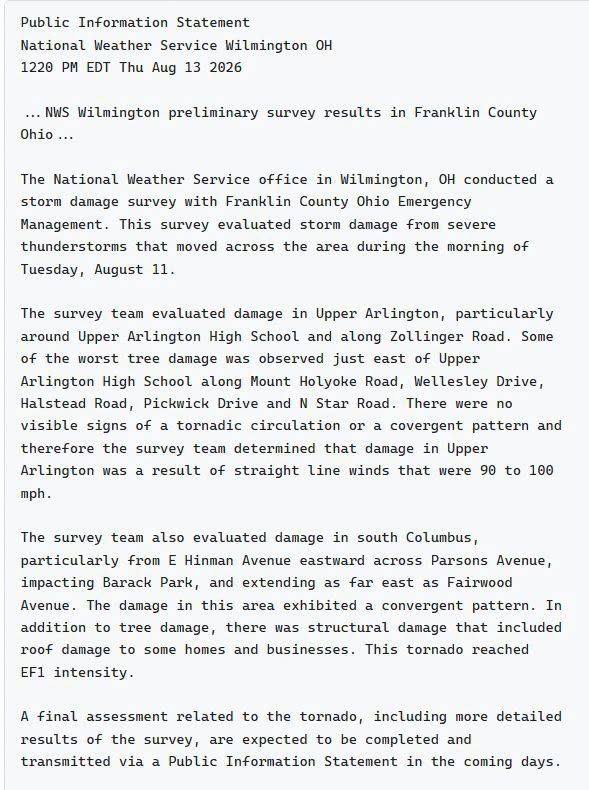
The National Weather Service and Franklin County Emergency Management surveyed damage Thursday from around East Hinman Avenue east across Parsons Avenue, through Barack Park and toward Fairwood Avenue.
Investigators found damaged trees, roofs, homes and businesses — but what separated this area from some of the other storm damage around Central Ohio was the way things fell.
The South Columbus damage showed a convergent pattern, which is consistent with rotating tornadic winds. The NWS preliminarily classified the tornado as an EF-1.
An EF-1 tornado falls in the 86-to-110 mph range on the Enhanced Fujita Scale.
Here’s something interesting, though.
Parts of Upper Arlington were hit by straight-line winds estimated at 90 to 100 mph — essentially overlapping with EF-1 wind speeds. But meteorologists found no evidence there of the converging damage pattern associated with a tornado.
So this wasn’t simply:
“South Columbus had stronger winds.”
In plain English?
Upper Arlington got slammed by destructive wind.
South Columbus got slammed by destructive wind that was rotating.
And these are still preliminary findings. The exact tornado path could be refined when the National Weather Service releases its final assessment.
And we were incredibly lucky.
Mayor Andrew Ginther called the lack of reported injuries at the city’s briefing “miraculous.”
The Columbus Division of Fire responded to more than 1,100 calls Tuesday, according to Ginther.
At the height of the emergency, 131 calls came in almost simultaneously, forcing every available emergency unit in the city into service.
But there’s some nuance here.
10TV later reported that Deanna Hunt and her seven children were inside their home off Parsons Avenue when the storm nearly split the house in half.
Hunt said her family rushed toward the basement as the storm moved through within seconds. She told 10TV one of her sons suffered cuts and bruises after debris crashed through a bedroom window.
The house was left unlivable.
Hunt and her children ended up at the temporary Red Cross shelter at Scioto Southland Community Center while trying to figure out what comes next.
And that right there is why I don’t want this story to end with:
“The National Weather Service confirmed a tornado.”
Okay.
We know what hit people.
Now what are we doing for them?
Here’s where you can get help right now.
One thing I wanted to get away from while reporting this story was that phrase government agencies love after disasters:
“Resources are available.”
Okay.
Where?
When?
And what happens when somebody actually walks through the door?
Franklin County Health and Human Services has begun putting its mobile unit into the community.
The next verified stop is:
Friday, Aug. 14 | 3–7 p.m.
Constant Love Foundation Back-to-School Fair
Marion-Franklin Recreation Center
2801 Lockbourne Road
County mobile-unit staff can connect residents with benefit applications, senior services, child-support assistance, reentry services and other county programs.
What I am still trying to get confirmed is exactly which storm-specific assistance applications staff will be able to complete onsite.
I’ve also been told by a Franklin County Health and Human Services source that county resources are expected at the Columbus City Schools Back-to-School Fair Saturday at Fort Hayes, 546 Jack Gibbs Blvd., from 10 a.m. to 1 p.m.
That is 10 to 1, not 10 to 2 as I was initially told.
As of Thursday evening, the county’s public mobile-unit calendar had not yet listed that Saturday appearance, so I’m keeping that information attributed to my county source until it is formally posted.
The city has also created one doorway for storm information.
Columbus has consolidated storm-response information into one city resource page.
For non-emergency city storm problems — including blocked streets, street flooding and sewer-backup issues — residents can use 311 or call 614-645-3111. Columbus identifies 311 as its central point for non-emergency city-service requests.
If your power is still out, open recreation centers and libraries that have electricity can also provide somewhere to cool down, charge devices and get online during their operating hours.
The American Red Cross shelter is at:
Scioto Southland Community Center
3901 Parsons Ave.
When I spoke with the Mayor’s communications office Thursday, I was told 23 people were staying at the shelter at that point.

Now let’s talk about the trees.
Because who owns the tree can determine who owns the problem.
The Mayor’s Office told me that if a city tree falls from the tree lawn onto private property, the city can respond.
If a tree is blocking the road, the city can respond to that too.
Call 311.
But if a tree falls from private property onto private property, cleanup is generally the property owner’s responsibility.
That becomes especially important if you rent.
The Mayor’s Office told me the Department of Neighborhoods has already heard from tenants whose landlords had not yet addressed storm-related tree damage.
Officials acknowledged that some property owners may be dealing with damage at their own homes first.
Fair enough.
But eventually, the rental property still has to be made safe.
The administration says Building and Zoning Services inspectors can become involved when landlords fail to address dangerous conditions.
That is something Kin+ is going to continue watching.
Now open your refrigerator.
Because this may be one of the biggest holes in the recovery system right now.
Imagine you grocery shopped Monday.
You spent $150.
Maybe $250.
Maybe more.
You’ve got kids at home, and that refrigerator is supposed to carry everybody until payday.
Tuesday comes.
Power goes out.
And after hours — or days — without electricity, everything goes in the trash.
If you receive SNAP, there is a process for seeking replacement benefits when food purchased using those benefits spoils during an outage.
Families are also being directed toward FreshTrak and the Mid-Ohio Food Collective to locate food distributions.
But I kept asking another question:
What if you don’t receive SNAP?
What if you work every day.
You make too much to qualify for food assistance.
But you still do not have an extra $250 sitting around to refill the refrigerator?
So far, nobody I’ve spoken with has identified a government program that replaces those groceries for non-SNAP households.
That does not mean somebody won’t eventually create one.
It means I cannot tell you one exists tonight.
And there is a difference between:
“Here’s a food pantry.”
and
“We’re replacing the $300 worth of food you just lost.”
There are also beginning conversations involving AEP and community partners about whether additional recovery assistance could become available.
But those are early conversations.
I do not have an approved reimbursement fund.
I do not have eligibility requirements.
I do not have an application.
Until somebody actually puts money on the table, I’m not going to tell families that checks are coming.
And then there’s AEP.
This is where the story started coming back to me from residents themselves.
Several residents and community leaders have told me that AEP notified them — or showed through its system — that their electricity had been restored.
Except their house was still dark.
One South Columbus resident posted publicly Thursday that everything she was seeing from AEP said her power was back on.
It wasn’t.
That raises some questions I want answered.
Because there is a pretty significant difference between:
“We know you’re out and we’re working on it.”
and
“Our system says your outage is over.”
If somebody gets marked restored when they are not, what happens?
Does AEP automatically know?
Does another crew get dispatched?
Does that customer have to report another outage?
Do they go back into the restoration queue?
And if households are showing as restored while they’re actually still without electricity, how does that affect the accuracy of the outage numbers everybody else is relying on?
AEP says customers should report outages directly so the company can track them and provide updates.
So if AEP says you’re restored and you’re not:
Report it again.
And document it.
Franklin County is now carrying most of AEP Ohio’s remaining outage burden.
At 5 p.m. Thursday, AEP said roughly 19,000 customers remained without electricity across its Ohio territory after crews restored more than 213,000 customers.
Live county-level tracking at that point showed approximately 17,500 Franklin County customers still without electricity.
In other words, by Thursday evening this was becoming less of a statewide outage story and increasingly a Columbus and Franklin County story.
And AEP is dealing with major infrastructure damage.
Its Thursday figures included:
163 broken poles
822 downed wire spans
143 broken crossarms
35 damaged transformers
That is serious damage.
And it absolutely helps explain why some repairs are taking time.
But here’s the distinction:
Major infrastructure damage can explain why the electricity is taking longer to restore.
It does not explain telling somebody it has already been restored when it hasn’t.
AEP’s remaining restoration target for northeast, northwest and southeast Columbus was noon Friday.
Its earlier target for southwest Columbus had been noon Thursday.
What I want now is something more granular.
Which South Side circuits actually met that deadline?
Which ones didn’t?
How many customers were still without electricity after the target?
And why?
Because telling Columbus that a region is “restored” means very little to somebody standing on one block in the dark.
If you are still out, save everything.
Screenshot your outage status.
Screenshot the restoration estimate.
Write down the time electricity actually returns.
Photograph spoiled food.
Save grocery receipts if you have them.
And keep documentation of the outage if you later need it for insurance, assistance or another claim.
So what exactly did the Mayor’s emergency do?
Mayor Ginther declared a Mayor’s emergency Wednesday.
I’m being intentional with that language.
That was a Mayor’s emergency — not the state declaration we’ll get to in a minute.
When I started asking how the city declaration actually works, I learned something interesting.
It is uncommon enough that officials themselves have been going back through records and processes to answer some of the questions I’m asking.
A spokesperson for Ginther told me the declaration is designed to let the administration expedite resources where they are needed during the emergency.
One city operation has already needed to purchase significant replacement power equipment.
The spokesperson pointed to extensive damage around Berliner Park, where roughly two dozen power poles were reported down.
Think about what Tuesday required.
Power equipment.
Tree removal.
Road closures.
Emergency crews.
Multiple government agencies coordinating at the same time.
All of that costs money.
So I asked:
Where is the money coming from?
And this is where City Council comes in — and where it doesn’t.
I had been calling Columbus City Council because I wasn’t seeing the same type of public storm announcements from Council that we were seeing from the Mayor and his senior administration.
Council’s communications office clarified something important for me.
Council does not manage the operational emergency response.
That work is being run through the Mayor and city administration.
Council is the city’s legislative branch, responsible for areas including budgets, contracts and legislation.
Individual Council members can still do constituent work — making calls, checking on neighborhoods and connecting residents with resources.
Councilmember Tiara N. Ross, for example, has been publicly showing herself out in the community talking with residents and connecting people with help. Ross currently represents Council District 7.
But Council isn’t running the emergency operation.
Where Council could become much more important is:
the money.
The Council spokesperson told me he is researching exactly how the finances work under a Mayor’s emergency.
What fund is paying for the response?
How much can the administration spend?
Is there a ceiling?
What happens if those dollars run out?
At what point does the Mayor have to come back to Council?
Does Council have to appropriate additional emergency money?
Those answers are still coming.
And they matter.
Because eventually, a storm recovery story becomes a budget story.
And now the state has stepped in too.
Thursday brought another significant development.
Gov. Mike DeWine amended Ohio’s existing storm state-of-emergency declaration to add Franklin County, joining Perry and Muskingum counties.
That means there are now two different emergency actions relevant to Columbus.
Ginther’s local declaration deals with moving city resources during Columbus’ emergency response.
DeWine’s declaration formally brings Franklin County under the state emergency response and gives Ohio greater flexibility to expedite state assistance.
But let me make something very clear:
“State of emergency” does not mean there is suddenly a FEMA check waiting for you.
It does not automatically mean individual FEMA assistance has been approved.
It does not automatically create grocery reimbursement.
It does not automatically replace somebody’s damaged roof.
It does not automatically reimburse lost wages or damaged property.
Federal Individual Assistance operates through a separate federal disaster-declaration and designation process. FEMA explains that governors request presidential disaster declarations and that eligibility for Individual Assistance depends on the resulting federal designation.
So the declaration opens another door.
Now we have to watch what actually comes through it.
What state equipment becomes available?
What personnel?
What financial resources?
Does Ohio help reimburse Columbus for its emergency spending?
Does the state help counties establish additional recovery programs?
Could this eventually lead to a request for federal assistance?
And ultimately:
How much of whatever comes next actually reaches the people on the South Side who need it?
Because government declarations matter.
But you cannot rebuild a bedroom with the words “state of emergency.”
Eventually, that declaration has to turn into something somebody can actually use.
Does confirming the tornado itself unlock more money?
I asked the Mayor’s Office that question too.
The answer I received was:
Not automatically.
The spokesperson said the National Weather Service officially determining that a tornado occurred does not by itself change the assistance Columbus is eligible to receive.
What the city is doing is documenting its storm-related expenditures in case some of those costs become eligible for federal reimbursement later.
That gives us another set of questions to follow.
How much does Columbus ultimately spend?
How much does the state cover?
How much could the federal government reimburse?
What does Columbus have to absorb itself?
And if more money is needed, when does City Council have to act?
Those may not be tonight’s questions.
But they are absolutely part of this story.
So where are we now?
Somewhere between emergency and recovery.
Power is coming back.
Trees are being cut down.
Roads are reopening.
Families are moving through shelters and resource centers.
But the lights coming back on does not mean everybody is okay.
Some families are returning to damaged homes.
Some people don’t have homes to return to.
Some renters are waiting on landlords.
Some families threw away hundreds of dollars worth of food.
Some residents say AEP told them their electricity was restored when they were still sitting in the dark.
And city, county and state officials are only beginning to determine what the final recovery will cost.
That is why this story cannot end with:
“An EF-1 tornado hit Columbus.”
We know that now.
My questions are:
Who is getting help?
Who isn’t?
Where is the money going?
Did AEP meet the restoration promises it made to neighborhoods?
What happens to families who don’t fit neatly into an existing government assistance program?
What does Ohio’s emergency declaration actually bring to Franklin County?
And when the cameras and press conferences go away:
Who is still going to be there?
If Tuesday’s storm affected your home, apartment or business, I want to hear from you.
Tell Kin+ your street or nearest intersection.
Tell us when your power went out — and whether it’s actually back.
Tell us what you lost.
Tell us which resources helped.
And especially:
Tell us where you’re still getting stuck.
Because the tornado may have lasted minutes.
South Columbus is going to be living with what it left behind for a lot longer.