

Rev. Jesse Jackson Death: The Impact That Outran the Legacy
Rev. Jesse Jackson is dead at 84, and America is already doing what it always does when a Black giant exits the stage: rushing to file him into a clean little folder labeled hero or problem.


Rev. Jesse Jackson is dead at 84, and America is already doing what it always does when a Black giant exits the stage: rushing to file him into a clean little folder labeled hero or problem. He deserves neither box. He deserves the truth.
Jackson died in Chicago after years battling a rare neurological disorder and related complications—another reminder that the body keeps score, even when the spirit refuses to stop moving.
Now, here’s the part folks are going to fight about: legacy. Jesse Jackson’s legacy is complicated; it includes towering wins, sharp elbows, public controversies, and a lifelong habit of standing right in the center of history’s camera frame. Fine. Debate it.
But impact? That’s the part that outruns the arguments. Because “His legacy is complicated; his impact is measurable.”
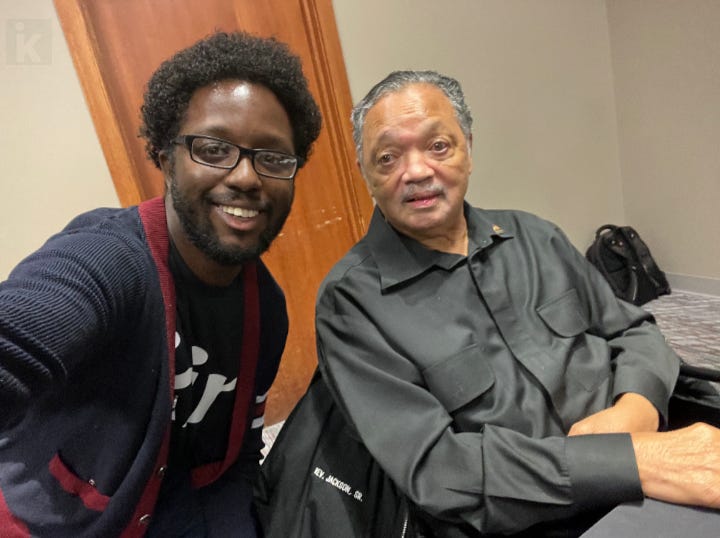
Here’s what was really happening
Jesse Jackson didn’t just “lead marches.” “Jesse Jackson didn’t just march—he built leverage.” He understood something a lot of people still don’t want to learn: moral clarity is powerful, but power respects pressure.
He took civil rights out of the nostalgia museum and into the operating system of American life: jobs, contracts, elections, corporate boardrooms, media gatekeeping, and the permanent fight over who counts as “the public.” He built organizations and coalitions meant to extract results—Operation PUSH and, later, the Rainbow/PUSH Coalition, which formalized that coalition model and kept it going long after cameras moved on.
And he did it with language that stuck to your ribs. “I Am Somebody” wasn’t just a chant—it was a corrective to a country trained to treat Black dignity as negotiable
If you want this kind of plain-spoken, culturally fluent analysis—without the corporate filters—join #KinFam. Kin+ is Where the group chat meets the truth., and membership is how we keep the lights on and the receipts organized.

Key moments
1) He turned coalition politics into an actual strategy
People throw around “coalition” like it’s a cute photo-op of everybody holding hands. Jesse treated it like warfare—with spreadsheets, targets, and consequences. “Rainbow politics wasn’t a vibe—it was a strategy.”
His whole approach was about expanding the table while refusing to beg for scraps. He pushed a multiracial, multi-issue frame—race, class, labor, gender, LGBTQ+ rights—then dared the Democratic Party to either grow up or get left behind.
2) He made Black presidential ambition thinkable on live TV
Jesse Jackson ran for the Democratic presidential nomination in 1984 and 1988, and no, he didn’t win. That’s not the point. The point is that he showed the country something it pretended it wasn’t ready to see: a Black candidate building a national coalition, stacking delegates, and forcing the party to say the quiet parts out loud.
Say it with your chest: “He made Black political ambition sound normal on national TV.”
And yes—if you’ve ever watched a candidate talk to Black voters like their campaign rent was due on Friday, “If you’ve ever watched a candidate court Black voters like their life depended on it, you’ve seen his fingerprints.”
3) He dragged corporate America into the conversation—whether it liked it or not
Jackson’s critics love to reduce him to microphones and theatrics. But the real work was often boring: boycotts, negotiations, demands, follow-ups, and the constant insistence that “diversity” isn’t a commercial—it’s employment, vendors, contracts, and decision-making.
This is where impact beats legacy every time. Movements can win hearts. Jesse tried to win budgets.
4) He practiced “freelance diplomacy” when the government couldn’t (or wouldn’t)
One of the wildest parts of Jesse Jackson’s career is how often he walked into geopolitical messes as a private citizen and walked out with people released. Reuters and other accounts credit him with helping secure the release of Americans held abroad and serving as an envoy to Africa during the Clinton era.
And whether you love that or hate it, it speaks to the same core principle: “He didn’t wait for permission from power; he negotiated with it.”

So what?
Black politics today is built on infrastructure he normalized. National campaigns courting Black voters, coalition math, movement language in policy debates—this didn’t appear out of thin air.
He proved protest isn’t the only lever—organized bargaining is. A march is a moment. An institution is a machine. Jesse built machines.
He modeled the cost of being “inside-outside.” When you pressure presidents and CEOs, you get results—and enemies. That tension shaped his whole public life.
He helped globalize Black freedom as a human rights issue. Tributes today highlight his anti-apartheid advocacy and international solidarity, which mattered because U.S. racial hierarchy has always been part of a global system.
And here’s the bluntest truth: “The debates about Jesse will fade; the doors he kicked open won’t.”
What could break this? (failure modes)
We turn him into a Hallmark quote instead of a playbook. “Keep hope alive wasn’t a slogan—it was a workload.” If we only keep the slogan, we lose the method.
Coalition politics collapses into clout politics. Jesse’s model required discipline, negotiation, and uncomfortable alliances—not just trending topics.
Institutions absorb the aesthetics of justice while resisting the economics of justice. He fought for contracts and jobs because symbolism alone doesn’t pay rent. That fight is still unfinished.

What to watch next (signals)
What happens to the Rainbow/PUSH Coalition now—leadership, priorities, and whether it stays a pressure organization or becomes a legacy brand.
How 2026–2028 Democrats talk about Black voters—substance vs. performance, policy vs. pandering.
Whether “economic justice” returns as a central frame (jobs, wages, contracts, education) instead of an afterthought.
How younger organizers talk about Jesse—do they inherit the coalition method or reject it as “old politics”?
The global tributes—especially from leaders and movements who saw him as part of a broader anti-racist, anti-apartheid international story.
Jesse Jackson will be argued about forever. That’s what happens when you spend your life applying pressure in public.
But the scoreboard matters more than the commentary. He expanded what Black America could demand, and he forced America to respond—sometimes with progress, sometimes with backlash, often with both.
His legacy is messy. His impact? It’s everywhere.

If you’re tired of sanitized obituaries and want coverage that tells the truth and explains the stakes, join #KinFam. Supporting Kin+ means backing Black-owned journalism that treats power like a system—not a celebrity.

Les Wexner, the Epstein files, and Columbus’ donation scramble

Columbus is doing that thing cities do when the vibes get toxic: everybody starts fumbling for the nearest bottle of hand sanitizer and pretending nobody touched the doorknob.
Wes Moore Went on "CBS’ Town Hall" and Said What Democrats Hate Hearing: Y’all Move Too Slow

By the time Norah O’Donnell finished setting the scene in Cambridge, Maryland—historic town, Underground Railroad lore, civil rights echoes—you could already tell what CBS wanted this hour to be: a glossy audition tape for Gov. Wes Moore as “the future of the Democratic Party.”
SOURCING / TRANSPARENCY FOOTER (sources used)
Associated Press • The Rev. Jesse Jackson… has died at 84 • Feb 17, 2026
Reuters • Jesse Jackson… dies at 84 • Feb 17, 2026
The Guardian • Jesse Jackson… dies aged 84 • Feb 17, 2026
The Washington Post • Jesse Jackson… dies at 84 • Feb 17, 2026
Rainbow PUSH Coalition • Brief History / Organization and Mission • (site pages)
Encyclopaedia Britannica • Operation PUSH • (page updated)
WTTW • Rev. Jesse Jackson… dies at 84 • Feb 17, 2026
This makes me so sad for this country, however he is a symbol of what CAN BE DONE HERE, He’s our martyr now, RIP
Congratulations, DaVante, on your article! We are consistently proud of you and your endeavors. I have prominently featured your photograph in our Hey Papi Promotions Network member highlights for everyone to admire. You can review it at https://heypapipromotions.com/celebrity-highlights/Network-member-DaVante-Goins-with-celebrity-Jesse-Jackson