

Renee Dion Put On Her Robe. The Festival Gets to Hear the Story.
Arts Festival Sessions | TalkBack on Kin+, presented in partnership with the Greater Columbus Arts Council

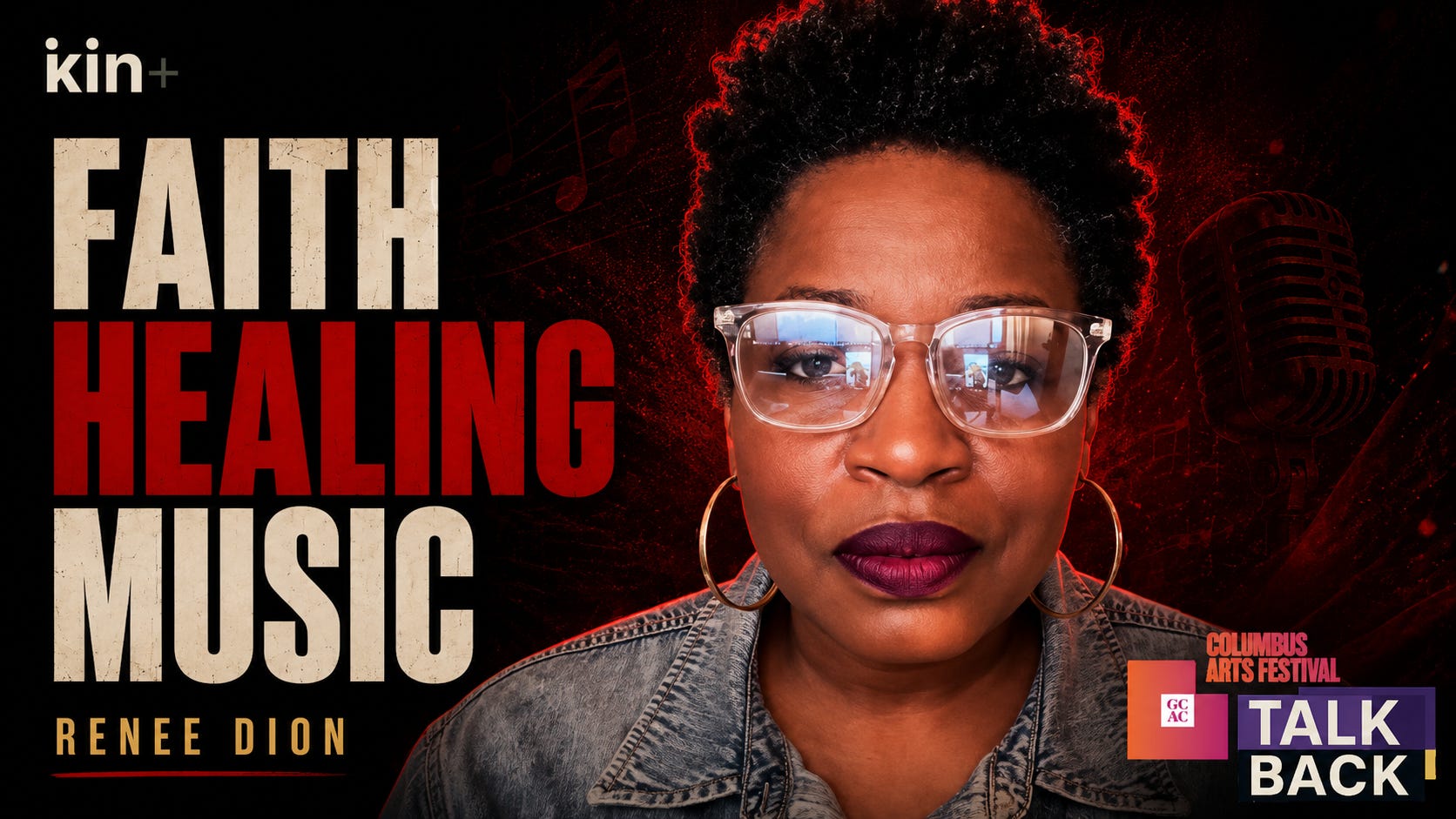
A note before we begin: This one comes to you in print. Some conversations survive the technology and some don’t, and this one didn’t — the recording won’t give us an episode. But what Renee Dion said in that room was too important to lose to a hard drive, so I’m going to do what Black writers have always done when the microphone failed: I’m going to tell you about it myself. — DaVante’ Goins
I opened that conversation by putting her in some company.
I told her that her music does what Whitney Houston and Gladys Knight and Stephanie Mills did on Home — when I think of home, I think of a place — and that her sound takes you somewhere the same way.
She was not having it.
“Look, at first I was like, now don’t compare me to them. Don’t have people coming to my show thinking they about to see Stephanie Mills with me.”
That is the first thing you need to know about Renee Dion. She will accept the love and decline the pedestal in the same breath. She’s protective of her audience’s expectations — she doesn’t want anybody walking up to a stage expecting somebody else. That’s not false modesty. That’s a working artist who knows exactly what she is and refuses to sell you a different woman.
Before we started recording, I asked how she was doing. She said she was blessed.
By that point in this series, I’d asked five Columbus artists that same question in five different rooms, and I already knew where it was going.
The thing I couldn’t follow up on
I need to be honest with you about a moment in this interview, because it was the most important thing that happened and I can’t hand it to you.
We were talking about pain. About what it costs a songwriter to go back into the hardest seasons of her life on purpose, to relive it in order to write it, and then to perform it in front of strangers night after night. I asked her whether that process was therapeutic — whether the writing and the singing gave her closure, and whether that closure travels to the person listening.
She answered. And what she said stopped me cold.
I studied philosophy in college. I have been on stages and behind microphones for going on fifteen years. Very little stops me mid-thought. That did. I had a whole next question ready and I put it down, because some things you don’t follow up on. You let them sit in the room and you let them be what they are.
I’ll tell you plainly: I can’t reproduce it here the way she said it, and I’m not going to paraphrase a woman’s testimony into something smaller than what she gave. What I can tell you is what it did. A conversation that had been an interview stopped being one. From that point forward it was two people in church.
Sade, Aretha, and letting the voice do the work
When I asked Renee for her favorite artist of all time, she went to Sade.
And the way she talked about Sade told me everything about her own practice. Not the hits. Not the aesthetic. The restraint. Sade lets the words and the voice do the work and doesn’t crowd the song with instruments it doesn’t need.
That’s a discipline, and it’s a hard one, because the temptation in every studio is to add. More layers, more production, more proof that you were there. Choosing to take away requires that you trust the voice.
We ran with it. I brought up Al Green — Love and Happiness, where for the first stretch all you get is that tap on the guitar, and it’s plenty. And we landed where that conversation always lands: Aretha. The GOAT in any genre, because she never needed the background. Just the voice.
From there we got into something I think about a lot. There’s a lineage running from the blues straight through to now, and people who dismiss hip-hop don’t understand that they’re dismissing their own grandparents’ music. You don’t get Lil’ Kim or Drake or Nipsey without B.B. King. The blues said the same things rap says; the only thing that changed was the tempo and who was uncomfortable.
We also spent a minute on the Bible as literature — which is one of my favorite pieces of writing on earth, and not only for the spiritual reasons. It is one of the most detailed, graphic, unflinching documents ever assembled. But you have to read it led by the Spirit, because some of what’s in there will hand you the wrong lesson if you come to it with the wrong eyes.
She met me at every one of those turns. That’s a musician who studies.
The season she’s in
Late in the conversation, I ran a few matchups at her. Drake or Kendrick. Kendrick or Nipsey — which is a tough one even for me, and I said so, because they’re both lyricists, both people whose power was in the pen. Prince or Luther. Yolanda Adams or CeCe Winans.
Then I gave her a fairer one: CeCe Winans or Tramaine Hawkins.
She went with Tramaine — and she framed it as being about the season she’s in right now.
The moment she said it, the song was already in my head. A change, a change has come over me.
That’s the whole conversation in one title. Everything we’d been circling — pain, patience, evolution, the way a life turns over — Tramaine had already sung it. And Renee reached for exactly that record for exactly that reason.
Which brought me to the Hawkins song I’d been holding the entire time.
The robe
Walter Hawkins, I Shall Wear a Crown:
I shall wear a crown. But I’m going to put on my robe, so I can tell my story about how I made it over.
That’s the theology of this entire conversation, and it is the reason Renee Dion’s music does what it does.
The crown is the reward. The robe is the testimony. And you do not get to the robe without walking through the thing you had to make it over. There is no shortcut to a story. You cannot sing what you have not survived.
I told her the framework I’ve been giving audiences for twenty years, and I’ll put it here for whoever needs it:
First, you have to let all that go. You cannot get where you’re going carrying every piece of it. It’s in the past. All it can do now is shape how you move forward.
Then you adapt the attitude that it had to happen. Not that it was fair. That it was necessary. If one thing had gone differently, I wouldn’t be sitting in this chair, and you wouldn’t be reading this.
Then you get up and do something with it. With the hurt, the trauma, the pain — all of it. The Isley Brothers already told us joy and pain are like sunshine and rain. You don’t get to pick one. You get to decide what you build with both.
And Ecclesiastes settled the rest a long time ago. To everything there is a season. A time to be born. A time to plant. A time to pluck up what’s been planted.
Renee Dion is in the season of the robe. She’s dressed and ready to tell it.

The praying grandmother
Somewhere in there I said the thing that turns a conversation into a family reunion.
There’s something about being able to say you had a praying grandmother.
Some of us know. Some of us are only here because a woman was down on knees that had no business being on a floor, at two or three or four in the morning, calling our names out to God when she should have been asleep and probably should have had surgery on those knees years earlier.
You cannot separate that from this music. Not Renee’s, not Tramaine’s, not any of it. The old gospel and the old Motown carry those women’s fingerprints. That’s why that catalog still moves a room fifty years later — it was prayed over before it was recorded.
What she’s doing now, and what we owe her
Renee is writing. She’s working on new music and she was deep in preparation for her Festival performance when we talked — which is why I want to close on the one piece of business she raised that I didn’t have time to open all the way.
She dropped some real game about how artists actually get paid, and it went right past a lot of people. We’re going to come back to that in a full conversation, because it deserves its own room.
Until then, here’s the part I’ll say for her, since artists are so often expected to be too gracious to say it themselves: talent ain’t free. If you want Renee Dion at your event, your church, your festival, your stage — she is reachable at reneedionmusic@gmail.com, and you should come correct.
Her music is out there. Go find it. Start wherever you want and let it take you home.
The Arts Festival Sessions is a five-episode special series of TalkBack on Kin+, presented in partnership with the Greater Columbus Arts Council, producers of the Columbus Arts Festival — and the better part of 365 days a year of work by Jami Goldstein and the entire GCAC team. The full series features Dre, Candace O’Neal, Renee Dion, Daniel Glass, and Tracy Powell of House of IsA, at welcomehomekin.substack.com.
And remember, Kin Nation: if you fall down, you can look up. Because if you can look up, you can get up.
Welcome Home.
— DaVante’ Goins is Founder and CEO of Kin Worldwide and Editor-in-Chief of Kin+.