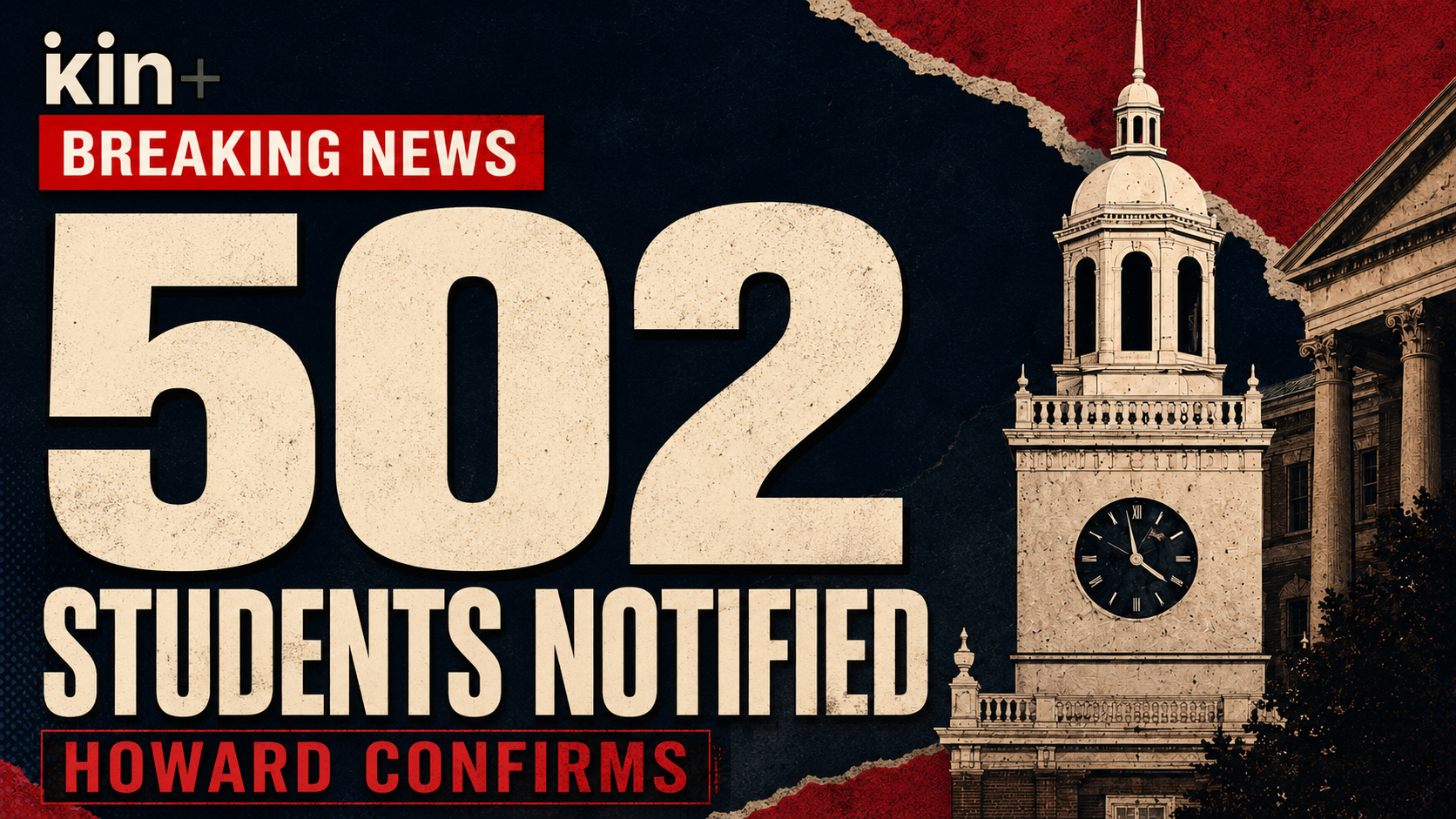
DEVELOPING: Howard University Confirms Enrollment Action, Leaves Deadline Questions Unanswered
Howard confirmed that it could no longer hold some incoming students’ places and acknowledged that students with pending aid may have been affected.
· Updated
Howard University has confirmed that some first-time-in-college students were told the university could no longer hold their places in the incoming class after they missed one or more financial requirements.
That is the first on-record acknowledgment from Howard of the enrollment action at the center of complaints from incoming students and families.
In a July 23 statement sent to Kin+ and posted publicly, Howard said students who did not meet what it called established payment, payment-arrangement, or scholarship and financial-aid reporting deadlines were notified that the university could no longer hold their place.
Howard also acknowledged that some students with pending outside scholarships or other financial aid may have been affected. The university said it is reviewing anticipated funding and will consider relevant circumstances presented by those students.
The response confirms that an enrollment action occurred. It does not resolve the central timing dispute.
Students and families in a video reviewed by Kin+ say incoming Class of 2030 students were required to have at least 50% of their account balance covered by July 10. Howard’s public Fall 2026 financial calendar lists August 3 as the payment deadline. The university’s statement did not confirm or deny the July 10 date or the reported 50% threshold, nor did it explain how any separate first-year deadline aligns with the date published on its website.
A circulating claim that approximately 500 students were affected also remains unverified. Howard did not provide a student count.

What Howard answered
Howard confirmed that an enrollment update was issued July 22.
The university said first-time-in-college students who missed payment, payment-arrangement or financial-aid reporting deadlines were told Howard could no longer hold their place in the incoming class.
Howard said it communicated with incoming students and families throughout March, April, May, June and July through emails, personalized financial-aid information, videos and Bison Prep sessions.
The university acknowledged that students with pending outside scholarships or other aid may have been affected and said it is reviewing those circumstances.
Howard directed students with enrollment-status questions to the Office of Enrollment Management, students with general scholarship or financial-aid questions to the Office of Financial Aid, and students with pending-scholarship or account-balance questions to the Office of the Bursar.
What Howard did not answer
Kin+ sent Howard 11 specific questions and requested the governing policy, student communications, cancellation notice, reinstatement instructions and an affected-student count.
The statement addressed parts of several questions but did not fully answer any of the 11.
Howard did not disclose:
- the exact deadline or written policy that triggered the enrollment action;
- whether first-year students were required to cover 50% of their balance by July 10;
- why the public financial calendar identifies August 3 as the Fall payment deadline;
- how many students were affected or whether the circulating estimate of 500 is accurate;
- whether admission, course registration, housing, deposits or some combination of those placements were lost;
- the form or process students were expected to use to report pending aid;
- whether Direct Loans, Parent PLUS loans, veterans benefits and third-party payments were counted before a student’s place was released;
- whether affected students can be fully restored, what documents are required or how long review will take;
- whether classes and housing will be protected while a case is under review;
- whether enrollment or housing capacity played any role; or
- whether Howard paused additional actions, extended a deadline or issued corrective guidance.
Howard also did not provide the March-through-July communications it referenced, including the reported June 8 instructions or the July 22 notice sent to students.
In the email transmitting the statement, Howard Media Relations told Kin+ that the office would follow up on questions the statement did not address. Kin+’s original inquiry requested complete written answers by noon Friday, July 24. Kin+ is awaiting that follow-up.

The public dates still do not line up
Howard’s Office of the Bursar lists August 3, 2026, as the Fall payment deadline. That page lists a Fall payment-plan window beginning in June and installment dates beginning July 15. It says Fall financial holds are expected in late September.
A separate Howard payment page also lists August 3 as the Fall payment due date. That page presents a different payment-plan schedule, with enrollment beginning July 15 and installments beginning August 15.
The two public pages are not fully aligned on the payment-plan schedule, but both identify August 3 as the Fall payment deadline.
Neither page reviewed by Kin+ displays a July 10 requirement for incoming students to cover 50% of their balance. Neither tells families that Howard may stop holding a student’s place before August 3.
That does not prove Howard lacked a separate first-year enrollment-confirmation policy. It means Howard has not yet produced that policy or explained where and when families were told that it controlled their place in the incoming class.
The financial-aid timing problem
Howard’s acknowledgment that students with pending aid may have been affected makes the missing details more urgent.
Howard tells parents and families that students may continue receiving balance notices even when financial aid will cover the bill. The university’s financial-aid guidance says no out-of-pocket payment is due when anticipated aid exceeds a student’s total charges.
That guidance says aid disbursements may begin up to 10 days before classes. Howard’s financial-aid terms say the first Federal Direct Loan disbursement for a first-time undergraduate borrower does not occur until 30 days after the first day of classes.
In plain English, a first-year student can have legitimate aid that is not yet cash on the account.
The university therefore needs a reliable way to distinguish between a student with no payment plan and a student whose accepted or documented funding has not finished moving through the system.
Howard’s statement acknowledges that some students in the second category may have been affected. It does not say how those students will get their places back.
Howard faced account-processing problems last year
The current enrollment action is not proof that Howard’s system failed again. It arrives one year after the university publicly acknowledged serious account-processing delays.
In July 2025, Howard said approximately 1,000 student-account updates had been delayed during its transition from BisonWeb to BisonHub. The university said it was expanding appointments, financial counseling, payment plans and emergency aid for students facing account challenges. Howard also said a significant number of its students are first-generation students. The university’s 2025 statement is available here.
That history does not establish what happened this summer. It does establish that Howard knows a delayed update, missing document or unclear deadline can determine whether a student reaches campus.
The clock is moving quickly. Howard’s academic calendar schedules orientation, academic advising and registration for new undergraduates from August 10 through August 14. Fall classes begin August 17.

Now, the read
Howard responded. That matters.
But a response is not the same thing as an answer.
The university confirmed the existence of the enrollment action, acknowledged that students with pending aid may have been caught in it and identified offices students can contact. Those are meaningful additions to the record.
Howard still did not identify the deadline that cost students their places, explain the difference between that deadline and August 3, say how many students were affected or promise that students removed while aid was pending will be fully restored.
Defending Black institutions does not require defending confusion.
Howard is one of Black America’s most important institutions. That is precisely why the standard should be high. Families should not have to choose between respecting Howard’s legacy and asking Howard to produce the rule that determined whether their child still had a place in the class.
There is another side to the responsibility. A viral number is not a receipt. Until Howard confirms the count or original records establish it, the claim that 500 students were affected must remain labeled unverified.
The verified story is already serious enough: Howard says it stopped holding places for some incoming students, and Howard acknowledges that some students with pending scholarships or financial aid may have been affected.
If the university applied a clearly disclosed policy correctly, it should publish the policy, the deadline and the communications. If students were swept up because aid was still moving, Howard should restore them quickly and protect their classes and housing while the review is underway.
The move
Affected students should contact Howard in writing:
- Enrollment status: enrollmentmanagement@howard.edu
- General scholarships and financial aid: finaid@howard.edu
- Pending scholarships and account balances: bursarhelp@howard.edu
Ask Howard to state exactly why your place was released, what remains missing, which office is deciding the case and when you will receive a written decision. Ask whether your course schedule, housing assignment and deposits will be preserved during review.
Preserve every March-through-July email, the July 22 enrollment update, BisonHub screenshots, financial-aid notices, outside-scholarship letters, housing records and course schedules.
Do not post student identification numbers, Social Security numbers, FAFSA information or private financial records publicly.
Kin+ is seeking original communications and account records from affected students and families. Send redacted documentation to davante@welcomehomekin.com.
Howard should now publish one clear page containing the controlling deadline, who it applied to, how pending aid was counted, the number of students affected and the complete restoration process.
The families do not need another maze. They need the map.
Welcome home.
If this reporting helped you understand Columbus better, come home to Kin.
Join Kin Nation and get Kin directly — the news, alerts, guides and stories shaping our community.